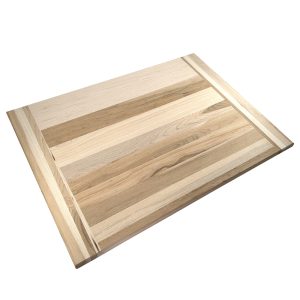
bakery cutting board
Bakery Cutting Boards
Flour gets into everything. Dough sticks where you don’t want it. And the knife never stops moving during a morning rush.
A board has to take all of that without complaint. Most don’t. The cheap ones warp by the third month, then a split creeps in along one edge, and now you’re buying again.
We source ours from Canadian hardwood. Three species, and they’re not interchangeable.
Maple does the heavy lifting. It’s pale, the grain sits tight, and it handles relentless knife work better than anything else on the counter. If you’re scoring baguettes all morning, this is the one.
Cherry’s a softer wood with a warm reddish tone. People put it out front because it photographs well and looks good under café lighting. Walnut goes the other direction entirely. Dark, dense, heavy in the hand. The kind of board that’s still around when the bakery changes owners.
Here’s the part most suppliers skip over.
Trees that grow in a cold climate grow slowly. That slow growth packs the rings in tight, and a board with tight rings is denser, holds up against moisture, and doesn’t let your dough grab the surface the way a soft imported board will. Density is the whole argument. It’s why these last.
Both halves of the day, covered.
Morning is dough work. Roll, knead, portion, dust, scrape it clean, start again. Afternoon flips to slicing and serving, a sourdough boule going out to a table, or loaves laid out at a market stall. Same board. No fuss.
Couple of things before you order.
This is wholesale. The minimum runs 24 boards per SKU, so it suits bakeries, cafés, and retailers stocking shelves, not a single board for the home kitchen. You can mix species and sizes across the order.
Need a batch spec’d for your bakery? Request a wholesale quote, list your species, sizes, and quantities, and we’ll turn pricing around quick.