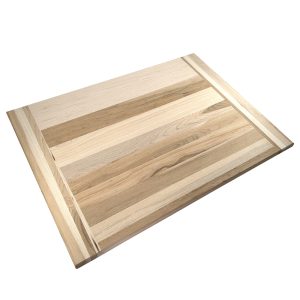
dough board
Dough Boards
Everything starts here. Before the oven, before the proof, it’s just a flat surface and a ball of dough waiting to be worked. Get the surface right and the rest gets easier.
A bad board tells on itself within a week. Dough sticks. The thing rocks on an uneven counter. Flour packs into hairline cracks you’ll never fully clean. Solid hardwood doesn’t do any of that.
Maple, cherry, walnut, all Canadian, all sourced for one job: a flat, steady, non-stick place to push dough around.
Most people reach for maple. There’s a reason. Grain so tight and smooth that a dusting of flour is all it takes for dough to let go instead of clinging. Roll, fold, rest, repeat. It stays on your side the whole time.
Warmer and a little softer, cherry mellows in colour the longer it’s around. Walnut’s the opposite end, dark and dense and heavy enough that it doesn’t budge while you lean into a roll. Bench, eye, preference, take your pick.
Why Density Decides Everything
Dough is wet. Wet is what finishes off a cheap board. The soft stuff soaks it up, swells, cups, splits. Dense wood refuses. Trees grow slow in a cold climate, rings crowd in tight, and you’re left with a hard surface that stays flat and dry batch after batch. Flat is the whole game, too. A warped board gives you uneven dough every single time.
A Shift on a Dough Board
Pastry rolled paper-thin. Loaves shaped by hand. Portioning, then dough left to rest under a cloth. That’s a shift on a dough board. When it’s over, a scrape and a wipe and it’s ready for the morning.
Ordering
Ordering’s simple. Wholesale only. The minimum is 24 boards per SKU. Bakeries, pizzerias, pastry kitchens, re