Food-Safe Finishes for Cutting Boards: Mineral Oil vs Beeswax vs Tung Oil

Walk into a kitchen store, search online, or ask in a woodworking forum and you’ll get three different answers about what to put on a cutting board. Mineral oil. Beeswax. Tung oil. Everyone has an opinion. Some of those opinions are well-informed. Others will damage your board or leave you using a finish that isn’t actually food-safe.
This post cuts through the noise. What each finish is, what it actually does, what the trade-offs are, and which one to reach for first.
Why the finish matters
A hardwood cutting board is a porous surface. Left unfinished, it absorbs moisture, food particles, and odours. That absorption is what causes warping, joint failure, and eventually the kind of surface degradation that shortens a board’s life by years. The right finish seals the wood’s pores, creates a barrier against moisture, and keeps the surface hygienic without adding anything that shouldn’t be in contact with food.
The wrong finish — or no finish at all — is the most common reason a good hardwood board fails early. The board itself wasn’t the problem. The
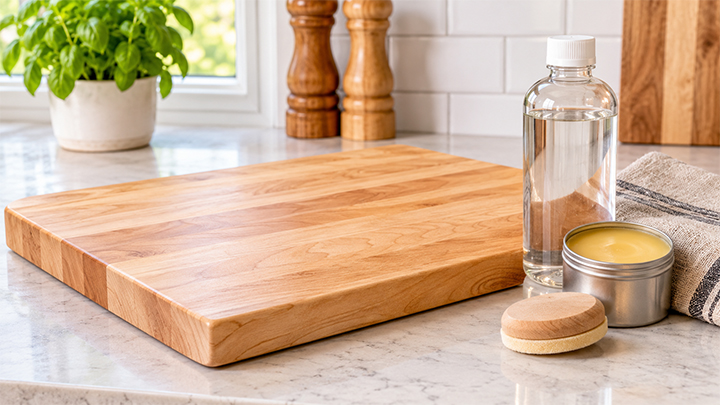
The right food-safe finish helps protect your hardwood cutting board and extend its life.
care routine was.
There’s also a wholesale consideration worth flagging: if you’re sourcing boards to resell or gift, the finish that comes on the board — or the absence of one — affects how the product performs in the customer’s hands. Boards that arrive pre-conditioned with food-safe mineral oil are ready to use. Boards that ship unfinished need to be treated before first use. That’s worth communicating clearly, because a customer who skips that step and sees early warping will blame the board, not the missed maintenance step.
What “food-safe” actually means
Not every oil or wax marketed for wood is safe for surfaces that contact food. Some finishes — teak oil, danish oil, linseed oil blends — contain drying agents, solvents, or other additives that are not food-safe once cured, or that require extended cure times before they’re safe to use. The finish categories that are genuinely food-safe are more limited than the shelf at a hardware store would suggest.
For cutting board use, the finishes that are consistently food-safe fall into three categories: food-grade mineral oil, natural waxes (beeswax, carnauba), and pure tung oil. Each works differently, suits different situations, and has genuine trade-offs worth understanding before you choose.
Mineral oil: start here
Food-grade mineral oil is the standard first finish for cutting boards, and it earns that position. It’s petroleum-derived, fully refined, odourless, tasteless, and completely inert in contact with food. It doesn’t go rancid. It doesn’t add flavour. It doesn’t react with food acids. And it’s inexpensive enough that you can apply it generously and repeatedly without thinking about cost.
The application process is simple. Pour mineral oil generously onto the board surface. Spread it across the full surface — both faces, all four edges, and the bottom. Let it absorb for a few hours, or overnight for the first treatment. Wipe off any excess that hasn’t absorbed. Repeat. For a new board, do this three to five times over the first week. The wood will stop absorbing at a certain point — that’s when you know it’s saturated. After that, monthly maintenance is usually enough, or when the surface starts to look dry.
Mineral oil’s limitation is that it doesn’t cure or harden. It stays in liquid form inside the wood fibres, which means it slowly works its way out over time, especially under heavy washing. A board maintained only with mineral oil needs more frequent reapplication than one that’s also been treated with wax. It also doesn’t build a surface layer — the protection is entirely from saturation, not from a film on top of the wood.
For most people and most boards, mineral oil alone is sufficient. It’s the right starting point for any new board, and for many boards it’s the only finish they’ll ever need.
Beeswax: the upgrade layer
Beeswax is almost always used in combination with mineral oil rather than as a standalone finish. The standard formulation — sometimes called board cream or board butter — is roughly one part beeswax melted into four parts mineral oil, then cooled into a soft solid. Some formulations add carnauba wax for a harder surface finish.
What beeswax adds is a surface layer. Unlike mineral oil, which soaks in, wax sits partially on top of the wood and partially in the surface pores. That layer provides better water repellency than oil alone — water beads more noticeably on a waxed board — and reduces how quickly the oil underneath works its way out. A board treated with beeswax blend needs less frequent reapplication than one treated with mineral oil only.
Beeswax also enhances the visual appearance of the wood. It brings out grain character and depth in a way that mineral oil alone doesn’t quite achieve. For decorative boards, serving boards, and anything where the visual presentation of the wood matters, beeswax finish is worth the extra step.
The limitation is that wax doesn’t penetrate deeply into the wood the way oil does. For conditioning a dry or new board, mineral oil needs to go in first. Applying wax to an un-oiled board gives you surface protection without the deeper moisture saturation that prevents warping and joint failure. The right sequence is always oil first, then wax once the oil is absorbed.
For boards being sold or gifted, a beeswax top coat is a good finishing touch. It presents better visually, performs better under the customer’s first few uses, and signals quality in a way that an oil-only board doesn’t quite communicate.
Tung oil: the nuanced option
Pure tung oil — pressed from the nut of the tung tree — is a drying oil that cures hard inside the wood fibres. Unlike mineral oil, which stays liquid, tung oil polymerizes over time and creates a harder, more durable finish that’s more resistant to water and food acids. For boards that see heavy daily use or harsher conditions, cured tung oil holds up better than mineral oil over time.
The critical word in that description is pure. Most products sold as “tung oil” at hardware stores are not pure tung oil. They’re blended products containing solvents, varnishes, or other additives that extend the product, speed up drying, or alter the finish. Those blends are not food-safe. For cutting board use, you need a product that specifies 100% pure tung oil, with no additives. That’s a narrower category than the shelf space devoted to “tung oil” products would suggest.
The other consideration is curing time. Pure tung oil takes longer to cure than mineral oil — typically 24 to 48 hours between coats, with three to five coats recommended for a good result. During curing, the board shouldn’t contact food. That waiting period is a practical inconvenience that mineral oil doesn’t require.
For most home cooks and most wholesale applications, mineral oil — with or without a beeswax top coat — is simpler, faster, and equally effective for all practical purposes. Pure tung oil earns its place for boards that will see particularly heavy daily use, for boards in commercial kitchen environments, or for end users who want maximum surface hardness and water resistance and are willing to put in the curing time to get it.
Side by side
Food-Safe Cutting Board Finishes
Finishes to avoid
A few finishes come up regularly in cutting board discussions that aren’t appropriate for food contact surfaces.
Vegetable oils — olive oil, coconut oil, sunflower oil — go rancid inside wood. The oil oxidizes, the board develops an off smell, and the rancid residue isn’t something you want on a food prep surface. These oils feel intuitive as a natural food product, but they’re the wrong choice for wood conditioning.
Linseed oil is sometimes suggested, but raw linseed oil takes weeks to dry and boiled linseed oil contains metallic driers that aren’t food-safe. Skip it.
Danish oil, teak oil, and similar blended products marketed at hardware stores almost always contain solvents and additives that make them unsuitable for food contact surfaces. The name sounds natural. The ingredient list often isn’t.
Polyurethane and varnish create a hard surface film that might seem like better protection, but they’re not designed for cutting board use. The surface film doesn’t flex with the wood’s natural movement — it cracks, peels, and chips, creating surface fragments that end up in food. These coatings belong on furniture, not cutting boards.
The practical routine
For the vast majority of cutting boards — home kitchen use, gifted boards, decorative serving boards — the right routine is straightforward.
Before first use: Apply food-grade mineral oil generously to all surfaces. Let it absorb for a few hours. Wipe off excess. Repeat three to five times over the first week until the wood stops absorbing readily.
Ongoing maintenance: Reapply mineral oil monthly, or when the surface looks dry. For boards you want to look their best — serving boards, engraved boards, gift boards — follow the oil with a beeswax blend once it’s absorbed. The wax adds surface sheen, enhances the grain, and reduces how often you need to re-oil.
When the surface needs restoration: A light sand with 180 grit removes the worn top layer and exposes fresh wood. Follow immediately with a heavy oil application. The board is effectively reset. This can be done multiple times over the life of a hardwood board.
What to avoid regardless of finish: Dishwasher use, prolonged soaking, and flat-drying on a wet counter are the fastest ways to shorten a board’s life. No finish compensates for those habits. Hand wash, dry standing upright, and store in a dry place — the finish does the rest.
The wood underneath still determines the outcome
The best finish routine in the world doesn’t overcome a board that was poorly made. Improperly dried wood keeps moving after you’ve finished it — no amount of mineral oil prevents a board from warping if the wood wasn’t brought to stable moisture content before it was milled. Loose glue joints open regardless of how well you’ve maintained the surface.
The right finish extends the life of a well-made board. It doesn’t fix the problems that come from a poorly made one. Eastern Canadian hard maple — grown slowly in cold climate conditions, kiln-dried to 6–8% moisture content, tight grain throughout — is the material that makes long lifespan possible. The finish keeps that material performing the way it’s supposed to.
For wholesale quantities of hard maple, cherry, and walnut cutting boards — kiln-dried, consistent batch to batch — see the full range at Wholesale Cutting Boards.