Bamboo vs. Wood Cutting Board: What’s the Real Difference?

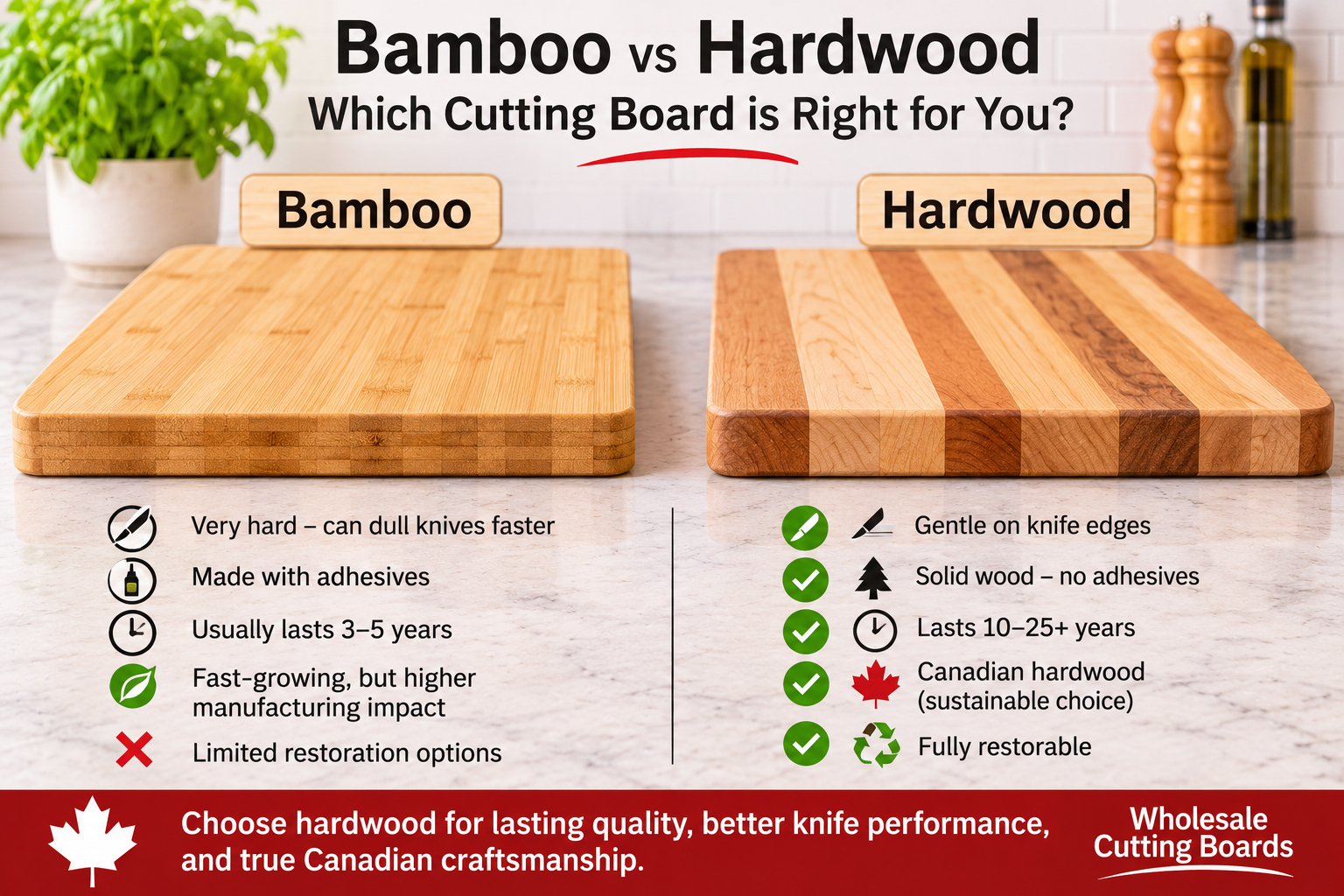
Bamboo or hardwood? A quality hardwood cutting board offers durability, easier restoration and long-term value.
Bamboo cutting boards show up everywhere — kitchen stores, big box retailers, online marketplaces. They’re marketed as eco-friendly, durable, and easy to maintain. Some of that is true. Some of it is marketing. And when you put bamboo next to a proper hardwood cutting board and compare them on what actually matters in a kitchen, hardwood wins most of the categories that count.
This isn’t about knocking bamboo. It’s about understanding what you’re actually buying when you choose one over the other — and why the people who care most about their tools keep coming back to hardwood.
First: bamboo isn’t wood
This surprises people. Bamboo is a grass, not a tree. Bamboo cutting boards are made by shredding bamboo stalks into strips, then binding them together under heat and pressure with adhesives. The result is a dense, hard panel — but the manufacturing process, the material, and the way it behaves in use are all different from solid hardwood.
That distinction matters because a lot of the claims made about bamboo boards — that they’re gentler on knives, more hygienic, more sustainable — depend on comparing bamboo to something it isn’t. When you compare it to actual hardwood, the picture looks different.
How they compare
Bamboo vs. Hardwood Cutting Board Comparison
The knife problem
Bamboo is very hard. That sounds like a good thing for a cutting board, but hardness in a cutting surface works against you above a certain point. When a knife edge contacts a surface that’s harder than it should be, the edge dulls faster — the steel rolls or chips rather than the surface yielding slightly to the blade.
Hard maple — the most common hardwood cutting board species — scores around 1,450 on the Janka hardness scale. Bamboo, depending on the specific product, typically scores between 1,500 and 1,800. That gap means bamboo is measurably harder on knife edges than maple, which is already one of the harder acceptable options for cutting boards.
Professional cooks and serious home cooks who sharpen their own knives and care about edge retention know this. It’s one of the main reasons you don’t see bamboo boards in professional kitchens where knife performance is the priority. The board that feels solid and durable is doing quiet damage to the tool that matters most.
The adhesive question
Because bamboo isn’t a wood with natural plank width, every bamboo cutting board is a composite — strips of bamboo fibre bonded together with adhesive under pressure. The adhesives used vary by manufacturer and by price point. Higher-quality bamboo boards use food-safe, formaldehyde-free adhesives. Lower-quality boards, which dominate the market at the lower end of the price range, may not.
This isn’t necessarily a dealbreaker for a well-sourced bamboo board, but it’s a variable that doesn’t exist in the same way with solid hardwood. A hardwood cutting board uses glue only at the joints between planks — a small fraction of the board’s total surface area. The rest is solid wood. A bamboo board is adhesive throughout its structure by necessity.
When bamboo boards are sanded — either for restoration or to smooth a rough surface — you’re sanding through adhesive layers, not just wood. This limits how aggressively you can restore a bamboo board compared to hardwood, where you’re working with solid material all the way down.
The sustainability argument, examined
Bamboo grows quickly — some species grow several feet per day — and it doesn’t require replanting after harvest. Those are genuine environmental advantages. The sustainability argument for bamboo boards leans heavily on this.
What the argument tends to skip is manufacturing. Most bamboo cutting boards are made in China, shipped long distances, and produced with industrial adhesives that require energy-intensive processing. The raw material is fast-growing, but the finished product isn’t particularly low-impact when you account for the full supply chain.
The other side of the sustainability equation is lifespan. A hardwood cutting board that lasts twenty years and gets restored twice along the way represents less total material throughput than three or four bamboo boards replacing each other over the same period. A well-maintained Eastern Canadian maple board, sourced from managed forests and milled locally in Québec, has a compelling sustainability case — not because of how fast the tree grows, but because of how long the product lasts.
Where bamboo does hold up
Bamboo boards are inexpensive. For a buyer who needs a large quantity of cutting boards at the lowest possible price point and doesn’t need them to last more than a few years, bamboo is a reasonable choice. They’re also lighter than most hardwood boards of equivalent size, which matters for some applications.
For everyday light-duty use in a setting where the board won’t be heavily used or maintained — a hotel room, a secondary prep surface, a cheap promotional item — bamboo does the job.
But if the board is going to be used seriously, displayed, engraved, gifted, or expected to last more than a few years, hardwood is the better material in almost every dimension that matters.
Which hardwood species to choose
Eastern Canadian Hardwood Species at a Glance
The bottom line for buyers
Bamboo boards sell well because they’re inexpensive and the marketing around them is strong. But the customers who buy hardwood cutting boards and care for them properly don’t go back to bamboo. The knife performance is better, the board lasts longer, it can be fully restored when it needs it, and the product tells a story that bamboo can’t match — genuine Canadian hardwood, made to last, from a region with a tradition of woodworking that goes back generations.
If you’re buying in volume for resale, the choice between bamboo and hardwood is also a choice about which customer you’re selling to. A customer who buys on price and replaces every few years is a bamboo customer. A customer who buys once, uses it for fifteen years, and recommends it to everyone they know is a hardwood customer. Both are real markets — but only one builds the kind of reputation that generates repeat business and referrals.
For wholesale quantities of hard maple, cherry, and walnut cutting boards from Québec’s Eastern Townships — 24-unit MOQ per SKU, kiln-dried, consistent batch to batch — see the full range at Wholesale Cutting Boards.