
2027 Cutting Board Trends: Less Plastic, More Hardwood, More Personalization

The cutting board market is shifting. Not dramatically, not overnight — but the direction is clear enough that wholesale buyers who pay attention now will be better positioned heading into 2027 than those who don’t.
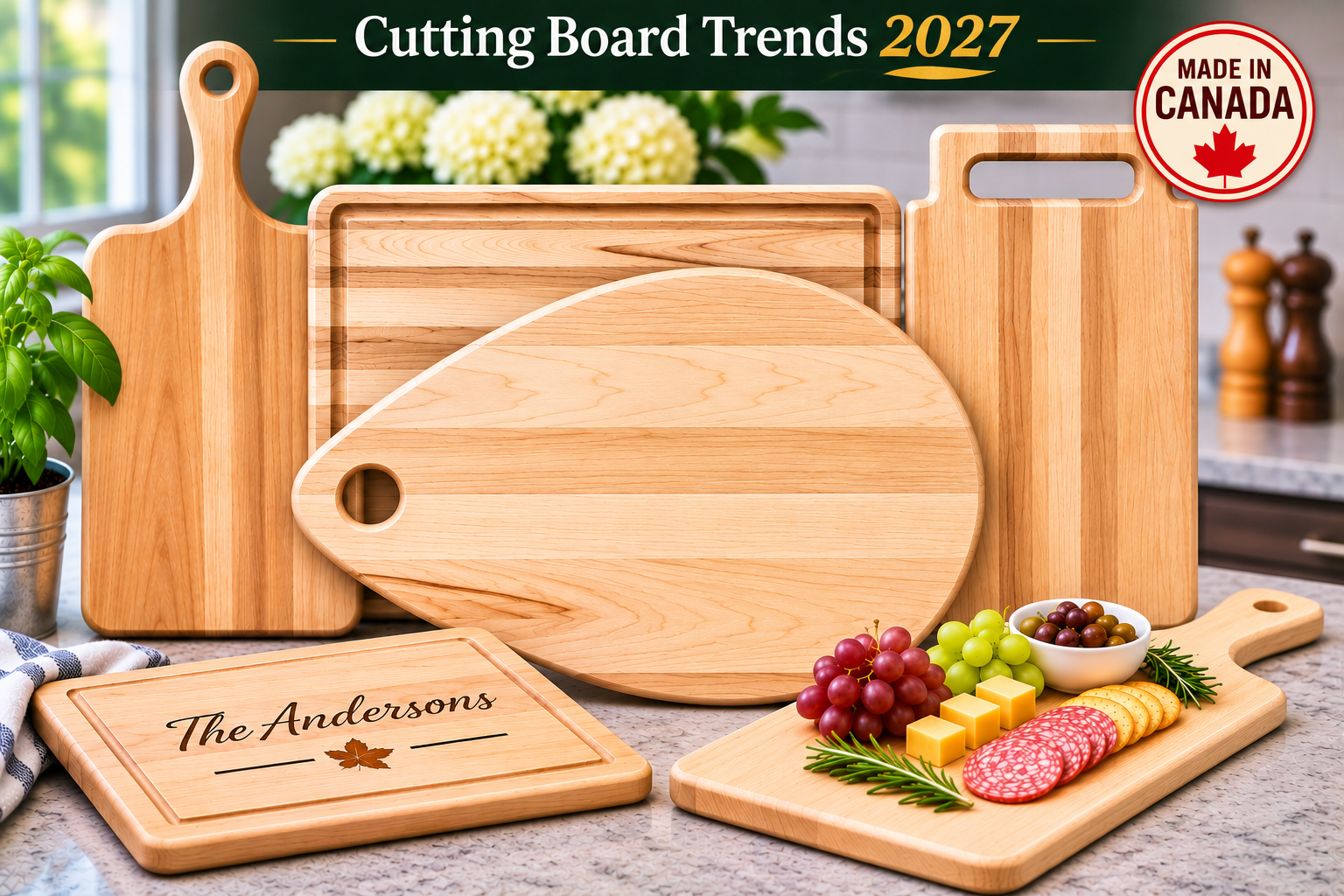
Cutting board trends for 2027 highlight Canadian hardwood, personalization, premium quality and versatile serving boards.
The opportunity in 2027 isn’t selling more cutting boards. It’s selling better cutting boards — ones that customers can personalize, give as gifts, display on their counter, and use for years without replacing. That shift is showing up across retail, foodservice, and the gift market, and it has real implications for what buyers should be sourcing.
Trend 1: Personalization is becoming an expectation, not a premium
A few years ago, a laser-engraved cutting board with someone’s name on it was a novelty. Today it’s a category. The personalized gifting market has grown to the point where consumers actively seek out customized products rather than stumbling across them, and cutting boards have become one of the go-to substrates for that market — weddings, housewarmings, corporate gifts, real estate closings, restaurant branding.
What this means for wholesale buyers: the blank matters more than it used to. A buyer sourcing boards for a laser engraver or a gift operation needs consistent surface quality, predictable grain, and species that photograph well after engraving. Hard maple is still the standard — pale surface, tight grain, sharp contrast after engraving. Cherry and walnut are gaining ground for premium gift tiers where the wood itself is part of the presentation.
The engravers and gift sellers who are scaling in 2027 aren’t buying whatever blank is cheapest. They’re building workflows around specific species and specific suppliers, because consistency is what lets them run production efficiently. That’s a wholesale opportunity for suppliers who can deliver the same board, the same way, every order.
Trend 2: The gift market is driving hardwood over bamboo and plastic
When someone is buying a cutting board as a gift — for a wedding, a housewarming, a holiday — they’re not buying on price. They’re buying on perceived quality, appearance, and the story the product tells. A bamboo board in a gift box doesn’t tell a great story. A solid hardwood board in maple, cherry, or walnut does.
The gift market shift toward hardwood isn’t just about aesthetics. Consumers have gotten more skeptical of bamboo’s environmental claims as the full picture — adhesive-heavy manufacturing, long supply chains, shorter lifespan — has become better understood. Hardwood from a known regional source, with a clear story about where it comes from and how long it lasts, lands better with a gift buyer in 2027 than it did five years ago.
For wholesale buyers supplying the gift channel, species mix matters. A maple-only offering covers the basics. Adding cherry and walnut opens the premium tier — higher retail price points, better margins, and products that photograph well for the kind of social sharing that drives repeat gift purchases.
Trend 3: Restaurants are rethinking their board programs
Plastic cutting boards dominated commercial kitchens for decades on the back of food safety assumptions that have since been challenged. The UC Davis research showing that bacteria on wood are drawn into the fibres and die — while bacteria on plastic survive in knife grooves — has quietly shifted the conversation in professional kitchens. Combined with growing consumer preference for the visual warmth of wood in food presentation, more restaurants are bringing hardwood back for both prep and service.
The serving board category — charcuterie, cheese, bread, shared plates — has expanded significantly and shows no signs of reversing. What started as a trend in upscale restaurants has filtered down to casual dining and catering. A restaurant that invested in hardwood serving boards three years ago is now replacing worn boards and expanding the program. That’s a recurring wholesale relationship, not a one-time order.
For wholesale buyers supplying the foodservice channel, the pitch in 2027 is longevity and restorability. A hardwood board that can be sanded and re-oiled lasts years longer than a plastic board that gets scored and replaced. That lifespan argument resonates with operators managing costs — and it’s one plastic can’t answer.
Trend 4: Branded products are moving toward things people actually keep
The promotional products industry has been dealing with a problem for years: most promotional items end up in a drawer or the recycling bin within months. The pivot toward higher-quality items that people actually use and display has been underway for a while, and cutting boards sit squarely in that category.
A branded hardwood cutting board — engraved with a company logo, presented at a client event or included in a corporate gift package — is something that stays on a kitchen counter. It gets used. It gets seen. It’s an impression that repeats every time the board comes out, for years. That’s a fundamentally different value proposition than a branded pen or a tote bag, and marketing buyers are increasingly willing to pay for it.
The constraint in 2027 is minimum order quantities. A corporate buyer who wants 50 branded boards for a client event needs a supplier who can deliver consistent quality on a reliable timeline. That’s where wholesale suppliers with real stock depth and batch consistency have a clear advantage over craft-level sources.
Trend 5: Buyers are consolidating suppliers
One of the quieter trends heading into 2027 is supplier consolidation. Buyers who were sourcing from three or four different suppliers — mixing species, sizes, and quality levels — are simplifying. The operational overhead of managing multiple supplier relationships isn’t worth it when one supplier can cover the full range.
What buyers are looking for in a consolidated supplier: multiple species (at minimum maple, cherry, walnut), multiple sizes, consistent quality batch to batch, and a minimum order structure that works for their volume. A 24-unit MOQ per SKU model fits this — low enough to test new species or sizes without overcommitting, and it scales as the product proves out.
The suppliers capturing consolidating buyers in 2027 are the ones who make it easy to order the full range from one place, with predictable quality and reliable lead times. That’s a relationship business, not a transaction business — and buyers who’ve been burned by inconsistent sourcing are specifically looking for the former.
What to look for in a wholesale supplier for 2027
2027 Sourcing Checklist for Wholesale Cutting Board Buyers
The bottom line
The cutting board market in 2027 is rewarding quality, provenance, and personalization. The buyers who are growing — in gift, in foodservice, in promotional products, in the engraving trade — are the ones sourcing better material and building real supplier relationships around it.
Eastern Canadian hardwood — maple, cherry, walnut, kiln-dried, milled in Québec’s Eastern Townships — is well-positioned for every one of these trends. The material is right, the story is right, and the sourcing model fits what consolidating buyers are looking for in 2027.
See the full range at Wholesale Cutting Boards.